


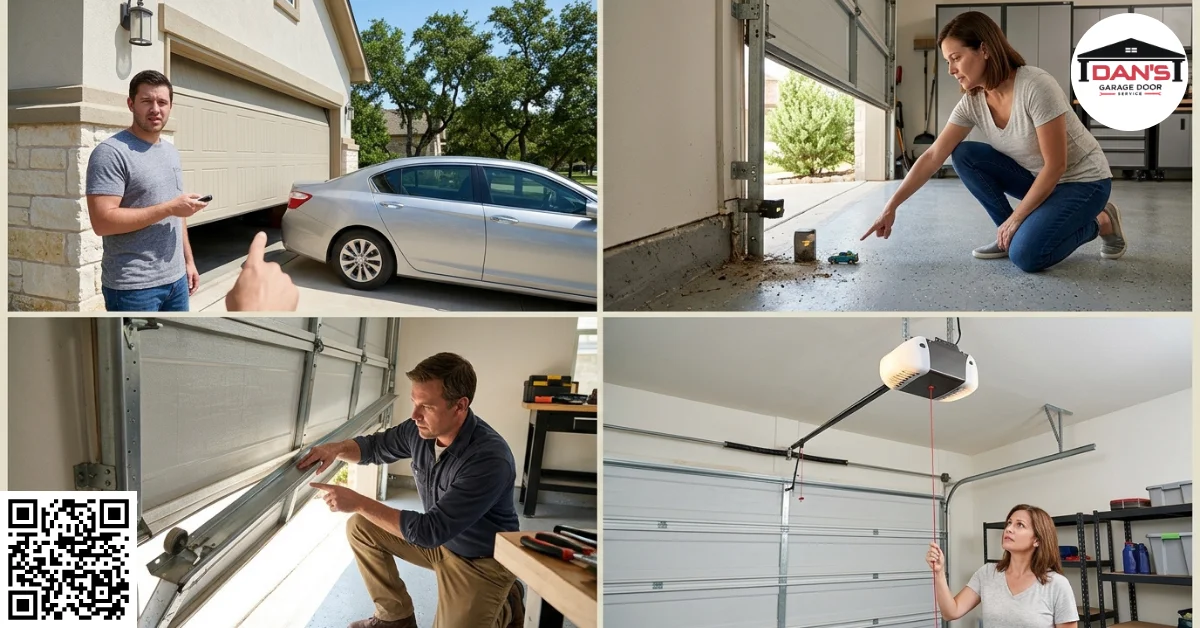

Imagine this: You are packing up the car for a fun family day at Landa Park, or maybe you are heading out early to beat the heat for a floating trip down the Comal River. You hit the wall button or your remote control to shut the garage door, backing down the driveway.
Nothing happens.
Or worse, the heavy door starts rolling down, stops halfway, flashes its lights, and opens right back up again.
A garage door that refuses to close is more than just an annoying roadblock to your weekend plans. It is a major safety hazard and a massive security risk for your home. Anyone or anything can walk right into your house, and in the blazing Texas summer heat, an open garage acts like a giant vacuum, sucking out your expensive air conditioning and driving up your utility bills.
At Dan's Garage Door Service, we have spent over 15 years servicing, fixing, and replacing garage doors throughout Comal County. We know exactly how our unique local climate—from the extreme summer humidity to those sudden, dusty Hill Country windstorms—affects the moving parts of your overhead door system.
Before you grab a hammer or panic, take a deep breath. As your trusted local garage door repair experts, we have put together this ultimate, step-by-step troubleshooting guide. We will walk you through exactly why your garage door won’t close, how to safely diagnose the problem, and when it is time to put down the tools and call in the professional team at Dan's Garage Door Service.
The Core Mechanics: How Your Garage Door Works
Before we dive into troubleshooting, it helps to understand what is actually happening behind the scenes when you press that button. Your garage door is the largest, heaviest moving object in your home. It relies on a delicate balance of mechanical tension, electrical power, and digital safety signals to operate smoothly.
When you trigger your garage door opener, it doesn't actually do all the heavy lifting. Instead, it acts as the brain and the initial catalyst. The real muscle comes from the counterbalance spring system (either torsion springs mounted above the door or extension springs on the sides). These springs store massive amounts of mechanical energy, neutralizing the door's weight so that it feels like it weighs only a few pounds.
As the motor turns, it drives a trolley along a steel rail. This trolley is hooked to the door via a curved arm. Cables attached to the bottom corners of the door wind or unwind around aluminum drums, lifting or lowering the panels smoothly along a track system guided by small rollers.
If even one tiny piece of this intricate puzzle fails—whether a wire snaps, a sensor gets dirty, or a spring breaks—the entire system shuts down for safety. Let's look at the most common reasons your door is stuck open.
1. The Number One Culprit: Misaligned or Blocked Photo-Eye Sensors
If your garage door starts to close but then instantly reverses and the overhead opener light starts blinking, you can bet money that your safety sensors are the problem.
What Are Photo-Eye Sensors?
Every automatic garage door opener manufactured after 1993 is legally required to feature infrared safety sensors. These are two small, camera-like boxes located about four to six inches off the ground on either side of your garage door track. One sensor emits an invisible infrared light beam (the sender), and the other captures it (the receiver).
If anything breaks this invisible beam while the door is closing, the system assumes a child, a pet, or an object is under the door. It instantly halts downward motion and reverses to prevent a crushing injury.
The Texas Dirt and Bug Factor
Here in New Braunfels, our environment loves to mess with safety eyes. We deal with plenty of blowing dust, limestone powder, pollen, and bugs.
- Cobwebs and Spiders: Mud daubers and spiders love the warm, sheltered nooks right around your garage door tracks. A single thick cobweb or a wasp nest built directly in front of a sensor lens will block the infrared beam completely.
- Dust and Grass Clippings: After mowing your lawn or during a dry, windy South Texas afternoon, a fine layer of dust can settle over the glass lenses, blinding the sensors.
- Vibration Misalignment: If you accidentally bump one of the brackets with a trash can, a lawnmower, or your foot, the two eyes will no longer point directly at each other. If they are even a fraction of an inch out of line, the beam is broken, and the door will refuse to shut.
How to Fix Sensor Issues Yourself
- Look for the Indicator Lights: Check the small LED lights on both sensors. One is usually green, and the other is amber or red. Both should be glowing steadily. If one is blinking or completely dark, they are out of alignment or lacks power.
- Clean the Lenses: Take a soft, microfiber cloth and gently wipe the glass lenses on both units to clear away dust, cobwebs, or debris.
- Clear the Path: Make sure there are no rakes, brooms, cardboard boxes, or tall weeds blocking the line of sight between the two boxes.
- Gently Realign: If a light is blinking, gently grip the metal bracket and bend it back into position until the indicator light stops flashing and shines solid.
2. Track Realignment and Physical Obstructions
Your garage door travels up and down along a pair of vertical and horizontal galvanized steel tracks. If these tracks aren't perfectly straight, or if something gets inside them, your door isn't going anywhere.
[Garage Door Panel] ---> [Roller] ---> [Steel Track] <-- (Must be clear and aligned!)
Twisted, Bent, or Dirty Tracks
Over time, the extreme heat cycles in Texas can cause wood framing to shift slightly, which can loosen the mounting brackets holding your tracks to the wall. If a track shifts outward or gets bent by an accidental bump from your car bumper, the rollers will bind and jam. The garage door opener will sense this sudden physical resistance, assume it hit an object, and reverse out of caution.
Furthermore, built-in grease, mixed with our local blowing dirt, creates a thick, sticky sludge inside the tracks. This sludge creates friction. If the friction gets too high, the motor's safety settings will kick in, stopping the door halfway down.
Inspecting for Obstructions
Walk along both sides of your garage door and look closely inside the curved channels of the tracks. Look for:
- Small pebbles or gravel kicked up by cars.
- Dropped screws, nails, or children's toys.
- Accumulations of hardened grease and dirt.
Safe Maintenance Tips
Never slather heavy grease or WD-40 inside your garage door tracks. Heavy grease acts like a magnet for dirt, making the problem worse over time. Instead, use a damp cloth and a mild degreaser to wipe the inside of the tracks clean. If you notice a visible bend or warp in the metal track, do not try to beat it back into shape with a heavy hammer. Hammering can create sharp kinks that destroy your rollers. Instead, call a professional for proper track alignment and garage door repair.
3. Broken Springs and Snapped Cables
If your garage door won’t close and you heard a loud, gunshot-like bang coming from your garage earlier in the day, you are likely dealing with a broken spring.
Torsion vs. Extension Springs
Most modern homes in the New Braunfels area use a torsion spring system. This consists of one or two tightly wound springs coiled around a steel shaft right above your garage opening. Older homes might use extension springs, which stretch out horizontally along the upper left and right ceiling tracks.
=================== [TORSION SHAFT] ===================
(XXXXX) Broken Gap (XXXXX) (XXXXXXXXXXXXXXXXX)
[Left Torsion Spring] [Right Torsion Spring]
Springs are rated by "cycles"—every time your door opens and closes counts as one cycle. Most standard builder-grade springs last between 10,000 to 15,000 cycles. Depending on how often your family drives in and out, they will naturally fatigue and snap after 5 to 7 years.
The Danger of Trying to Force a Door with a Broken Spring
When a spring breaks, the door becomes an incredibly heavy dead weight. If the door is already open and you try to force it down manually or override the opener, the entire weight of the door can crash down all at once. This can rip the automatic opener right out of the ceiling drywall, destroy the door panels, or cause severe bodily injury.
If you look up above your door and see a clear, two-inch gap in the middle of your spring coil, do not touch the door. Leave it alone and immediately contact an experienced technician. Replacing these high-tension components requires specialized winding bars, professional training, and extreme care.
4. Incorrect Limit Settings and Force Adjustments
Sometimes the issue isn't mechanical or physical; it's electronic. Your garage door opener features internal programming dials or digital menus known as "limit switches" and "force settings."
Understanding Travel Limits
The travel limit tells the motor exactly how many revolutions it takes to move the door from fully open to completely closed.
- Too Short: If the limit is set too short, the door will stop before it touches the concrete driveway, leaving a gap for critters and weather.
- Too Long: If the limit is set too long, the door will hit the concrete floor, think it has crashed into an object because it hasn't reached its digital "stop" point yet, and immediately bounce back up to the top.
Seasonal Fluctuations in New Braunfels
The soil in our region is packed with clay, which expands and contracts dramatically between dry spells and heavy rainstorms. This shifting soil can cause your garage floor concrete pad to rise or sink by half an inch over the years. This slight shift changes the distance your door needs to travel.
If your door closes, hits the ground, and instantly pops back up, your down-travel limit needs a minor adjustment. Most modern openers have simple arrow buttons on the back of the motor casing to adjust this, but changing these settings incorrectly can strip your internal plastic gears. If you aren't comfortable programming electronics, it's always best to have a local technician calibrate it for you.
5. Remote Control, Wall Button, and Wiring Glitches
If your wall button works perfectly but your remote controls do nothing when you pull into the driveway, you are looking at a wireless or electrical connectivity breakdown.
The Simple Stuff: Dead Batteries and Lock Switches
Before assuming the worst, check the easiest solutions first:
- The Lock Feature: Check the control panel mounted on your wall inside the garage. Many models have a "Lock" or "Vacation" button. If this button is accidentally pressed, it locks out all radio frequencies. Your remotes will not work, though the wall button still will. Press and hold the lock button for a few seconds to unlock it.
- Dead Remote Batteries: If the small LED light on your keychain remote doesn't light up brightly when pressed, drop by a local shop and grab a fresh CR2032 or AAA battery.
Radio Frequency (RF) Interference
New Braunfels sits right next to major military flight paths and a growing telecommunications infrastructure. Occasionally, local radio frequency interference from military bases, nearby cell towers, ham radios, or even cheap LED light bulbs installed inside your garage opener housing can block the signal between your remote and the opener antenna.
If you notice your remotes only work when you are standing right next to the door, try switching out your garage light bulbs for specialized, shielded garage-door-compatible LED bulbs that do not emit electronic noise.
Comprehensive Troubleshooting Matrix
To make finding your problem as fast as possible, use this simple reference chart to match your symptoms to the most likely cause and solution.
What You See / Hear | What It Usually Means | What You Should Do |
Door starts down, stops, flashes lights, and goes back up. | Safety photo-eyes are dirty, blocked, or misaligned. | Clean lenses with a cloth and realign brackets until lights are solid. |
Door shuts completely, hits the ground, and instantly opens up. | The down-travel limit setting is set too far down. | Adjust the down-travel limit screw or digital setting on the motor. |
The motor makes a humming sound, but the door doesn't move at all. | Broken torsion spring or a jammed/locked mechanism. | Check for a gap in the spring above the door. Call a professional immediately. |
The wall button closes the door, but wireless remotes do not respond. | The wall console lock mode is active, or the remote batteries are dead. | Deactivate the lock button on the wall panel or replace remote batteries. |
The door moves down unevenly, tilts, and jams in the tracks. | A lift cable has come off the drum or snapped on one side. | Do not operate the door. Call for emergency garage door repair services. |
Crucial Safety Warnings: What NOT to Do
When a garage door is stuck open, it's natural to feel frustrated and want to force it closed so you can secure your home. However, making the wrong move can turn a simple $100 repair into a multi-thousand-dollar medical bill or structural replacement.
The Danger of High-Tension Components
The springs and cables supporting your garage door carry enough stored energy to slice through thick materials or break bones if they break under tension.
- Never try to unscrew the red-painted bolts on the bottom corner brackets of your door. These brackets are under direct tension from the lift cables.
- Never attempt to adjust or wind a torsion spring using makeshift tools like screwdrivers or pliers. Professional technicians use hardened steel winding bars designed specifically for this job.
Overriding the Emergency Release Cord
Every opener features a hanging red rope with a plastic handle. Pulling this cord disconnects the garage door from the automatic opener carriage, allowing you to lift or lower the door by hand.
CRITICAL SAFETY NOTE: Only pull the red emergency release cord if the garage door is fully closed. If you pull this cord while the door is stuck open, and you have a broken spring or snapped cable, nothing will be left supporting the weight. The door will slam down instantly like a guillotine, destroying anything beneath it.
Preventive Maintenance Tips for New Braunfels Homeowners
The best way to fix a garage door that won't close is to prevent it from failing in the first place. By spending just 15 minutes twice a year inspecting your garage system, you can catch minor wear and tear before it turns into an emergency.
1. The Visual Inspection
Every six months, open and close your door while standing safely back. Listen for unusual grinding, squeaking, or scraping sounds. Look closely at the springs to check for rust or gaps, and examine the steel cables for any signs of fraying or loose strands.
2. The Balance Test
Test the physical balance of your door to make sure your springs are doing their job:
- Close the door completely.
- Pull the red emergency release cord to disconnect the opener.
- Lift the door manually up to hip level and let go.
- The Result: A perfectly balanced door will hover in place or drift down very slowly. If the door instantly crashes down to the floor, your springs have lost their tension and need professional calibration.
3. Lubricating Moving Parts
Keep everything running smoothly by lubricating the moving metal components once a year. Use a high-quality silicone or lithium-based spray lubricant. Spray a light coating onto:
- The steel rollers (specifically the roller bearings).
- The hinges linking your door panels together.
- The bearing plates on the outer ends of the torsion bar.
- The lock locks and springs.
Avoid spraying the tracks themselves, and never use WD-40, which acts as a degreaser rather than a long-term lubricant.
When to Put Down the Tools and Call a Professional
As a homeowner, handling basic maintenance like wiping down safety sensors, swapping out remote batteries, or sweeping out a dusty track is completely safe and encouraged. But recognizing your limits is key to keeping your family safe.
You should immediately call a certified local technician if you notice any of the following problems:
- A gap in your overhead torsion spring.
- Frayed, loose, or completely snapped steel lift cables.
- A door that is visibly hanging crooked or has slipped off its tracks.
- A cracked, bent, or heavily damaged structural door panel.
- A burning electrical smell or smoke coming from your opener motor housing.
Professional garage door repair companies carry proper insurance, have specialized heavy-duty replacement parts on their trucks, and offer warranties on their labor, giving you total peace of mind.
Frequently Asked Questions (FAQs)
Can I manually close my garage door if the safety sensors are broken or out of alignment?
Yes, you can manually override the safety sensors by pressing and continuously holding down the red wall button inside your garage until the door completely touches the floor. If you let go of the wall button before the door finishes closing, it will instantly reverse and open back up.
Why does my garage door only refuse to close during the sunniest times of the afternoon?
Direct, blinding sunlight shining straight into the lens of the receiving safety photo-eye can overpower the infrared signal, making the sensor think there is an obstruction. You can easily fix this by building a tiny cardboard sunshield tape-wrapped around the sensor or swapping the physical positions of the sending and receiving units.
How much does a professional garage door spring replacement typically cost in Texas?
Depending on the size, weight, and configuration of your garage door, a professional torsion spring replacement generally ranges from $200 to $450, which includes the cost of high-cycle parts and expert labor. It is highly recommended to replace both springs at the same time, as they have experienced the same amount of wear and tear.
Is it safe to use my garage door opener if one of the lift cables looks slightly frayed?
No, you should never operate an overhead door with a frayed cable, because the immense tension can cause it to snap completely at any moment. If the cable snaps while the door is moving, it will cause the door to crash down crookedly, damaging the tracks, rollers, and panel sections.
Final Thoughts
A garage door that won't close can turn a wonderful day into a stressful scramble. Whether the fix is as simple as wiping a layer of Hill Country dust off your safety eyes or as complex as dealing with a high-tension broken spring, understanding how your system works keeps you safe and in control. Always remember to start with the easiest, safest checks first, and never take unnecessary risks with high-tension mechanical components.
How Can Dan's Garage Door Service Help You?
If you have tried the basic troubleshooting steps and your door is still stuck wide open, don't leave your home, family, and belongings exposed tonight. Dan's Garage Door Service is standing by to provide fast, reliable, and friendly garage door repair right here in New Braunfels, TX.
With 15 years of hands-on technical experience, our professional crew knows exactly how to fix your springs, tracks, sensors, and openers safely and affordably the very first time. We pride ourselves on transparent pricing, exceptional workmanship, and fast service to get your daily routine back on track.
Don't risk your safety trying to handle heavy, dangerous doors alone. Give your local neighborhood experts a call today or come stop by our office to schedule a technician visit!
- Business Name: Dan's Garage Door Service
- Business Address: 2780 Wegner Rd, New Braunfels, TX 78130
- Phone Number: (210) 708-9042